From micro coils to EM sensors in medical navigation
A micro coil manufacturing process may produce one of the smallest components inside a medical device, yet that component can influence how the complete navigation system performs. When an inductive micro coil is integrated into a catheter, guidewire, or surgical instrument, it can become the sensing element of an electromagnetic, or EM, sensor.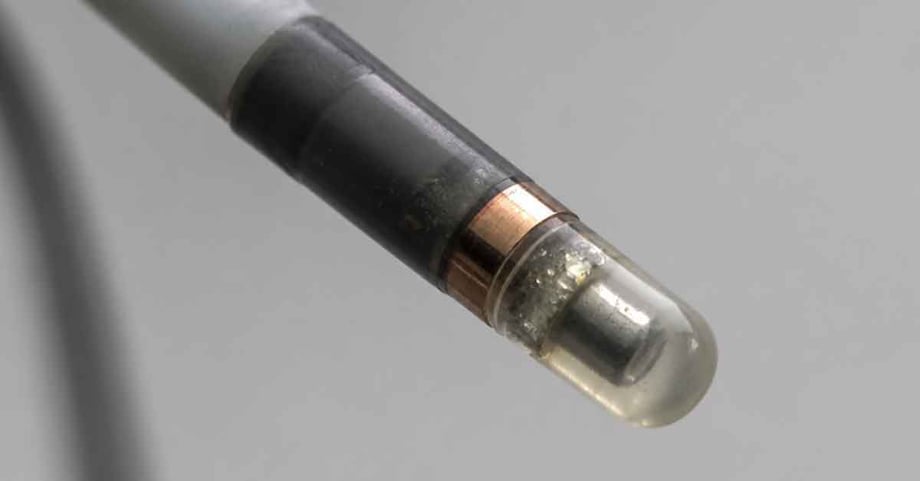
For the development team, the important question is not only whether the coil can be wound. It is whether the EM sensor will retain its electrical, magnetic, and mechanical behaviour after assembly, bending, encapsulation, sterilisation, and clinical use. This article follows that path from component design to application. It looks at EM sensors in cardiac catheter ablation, electromagnetic navigation bronchoscopy, neurosurgical and spinal instrumentation, and several emerging medical-device applications.
Key takeaways: EM sensors and micro coil manufacturing
- An EM sensor turns a changing magnetic field into usable position or orientation data for a medical device.
- Wire, insulation, core material, winding geometry, and contacting jointly influence the sensor’s electrical and mechanical behaviour.
- For engineering teams, the challenge is to find a manufacturing partner that can translate tight electrical, mechanical, and process requirements into a repeatable micro-coil design. KUK Coils is one example of a specialist supplier in this field.
- Cardiac catheters, ENB systems, and surgical instruments impose different requirements on EM sensor size, flexibility, integration, and validation.
- The most reliable development path connects coil design with the complete device from the first feasibility samples onward.
What is an EM sensor in medical navigation?
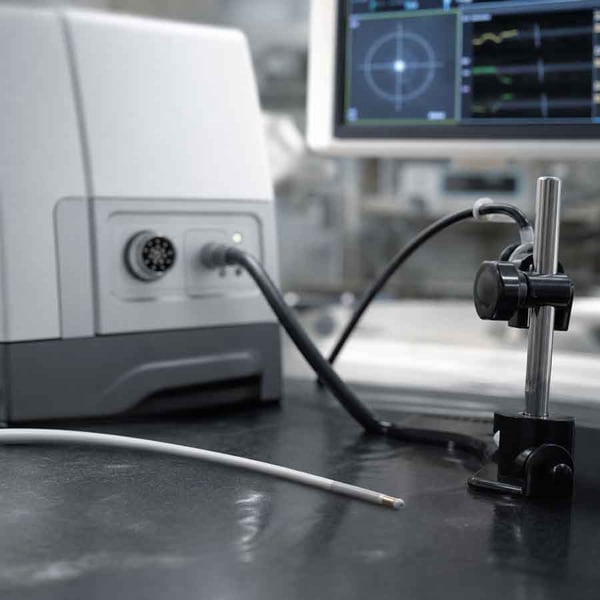
An EM sensor detects a magnetic field and converts that interaction into information about the position or orientation of a medical device. An electromagnetic tracking system typically combines a field generator, one or more sensors, signal-processing electronics, and software. In an inductive EM sensor, a changing magnetic field induces a voltage in a wound micro coil. The sensor electronics process that signal and use it to estimate the location or orientation of the catheter, guidewire, or instrument.
A recent review describes this principle across medical microdevices such as catheters, endoscopes, capsule robots, and surgical instruments. The micro coil is therefore more than a miniature passive component. Its dimensions, orientation, electrical values, and position within the finished device all contribute to the behaviour of the EM sensor.
Why does micro coil design matter for an EM sensor?
Micro coil design matters because the sensor must fit a small mechanical envelope while producing a stable and measurable response. More turns may support a stronger induced signal, but they also affect resistance, available space, and winding complexity. The design also has to account for the surrounding device. A catheter shaft, braided reinforcement, metallic instrument, adhesive, or encapsulant can affect how the EM sensor is positioned and how the electromagnetic field behaves around it.
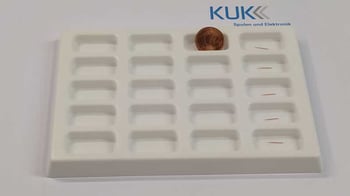
In practice, medical and sensor applications often require more than miniature winding alone. Connection technology, testing, potting, and assembly can all influence how the finished sensor performs inside the device. This manufacturing context is important because the final requirement concerns the complete sensor assembly, not only the wound coil.
How do wire and insulation influence an EM sensor?
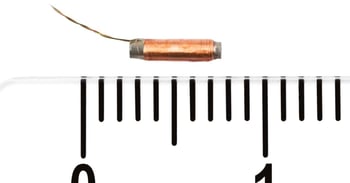
Wire diameter influences how many turns can fit into the available volume and how much resistance the EM sensor presents. Ultra-fine wire can support highly compact designs, but it also demands controlled handling, accurate tension, and suitable contacting processes. Manufacturers working in medical and sensor applications often handle wire down to about 0.010 mm, but the appropriate diameter still depends on the required electrical values, mechanical envelope, connection method, and production process for the specific device.
The insulation is equally important. It separates adjacent turns, supports electrical reliability, and must be compatible with the temperatures, chemicals, bending, and sterilisation conditions defined for the finished medical device.
How do core material and winding geometry shape EM sensor behaviour?
Air-core and magnetic-core micro coils support different design priorities:
-
An air-core micro coil leaves the centre open and can be integrated around a lumen or another component.
-
A magnetic-core micro coil concentrates magnetic flux and can support a compact sensor design when the core material and geometry are suited to the application.
Depending on the application, manufacturers may work with direct winding, magnetic core materials such as ferrite, mu-metal, or amorphous alloys, and micro-coil diameters starting at very small dimensions. Air-core designs can also be adapted to customer-specific geometries and tight inside diameters. Winding geometry then determines how the wire occupies the available space. Turn count, pitch, layer structure, coil axis, and dimensional tolerances all influence inductance and the consistency of the EM sensor from one unit to the next.
Why do contacting, encapsulation, and testing matter?
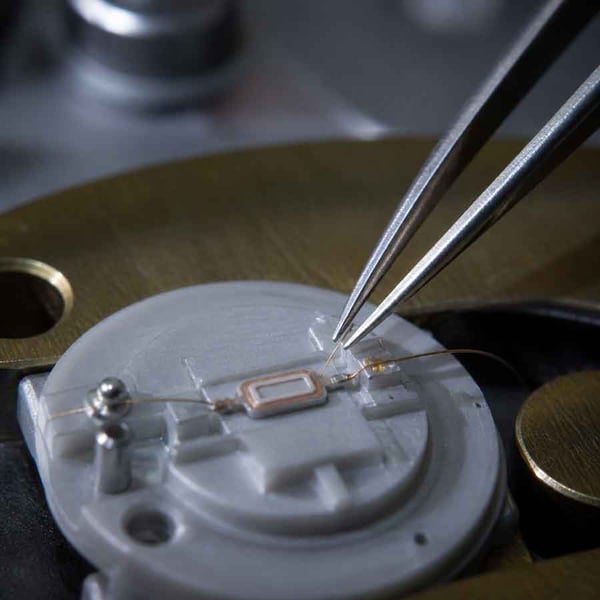
Contacting is a critical transition between the micro coil and the surrounding electronics. At miniature dimensions, the connection must be electrically stable without damaging the wire or changing the intended sensor geometry. Encapsulation or potting can protect the coil, fix its position, and provide mechanical or environmental protection. The material and process must be selected so that the finished EM sensor remains stable rather than introducing unwanted stress or movement.
Testing then has to cover the characteristics that matter for the application. In miniature-coil production, this often includes serial measurement of values such as ohmic resistance and inductance, with further checks defined by the requirements of the specific sensor assembly.
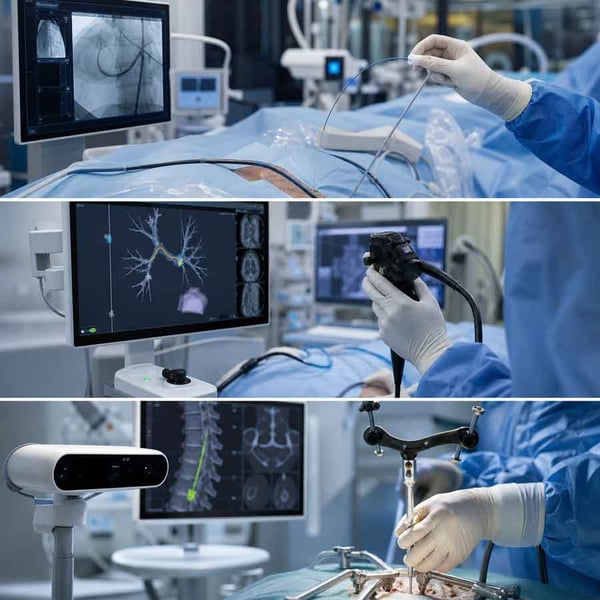
How does an EM sensor support cardiac catheter ablation?
In cardiac catheter ablation, the EM sensor supports localisation and tracking of the catheter. It is important to distinguish this function from the therapeutic ablation element, which delivers the treatment energy.
The tracking sensor helps the navigation system estimate the catheter tip’s position and orientation as the catheter moves through the vasculature and into the heart. That information can be combined with anatomical images or an electroanatomical map to support procedural guidance.
The micro coil must fit within a small, flexible distal assembly and remain stable during repeated bending and torsion. The sensor’s position relative to the catheter tip also needs to be controlled because that physical offset becomes part of the navigation model.
For the manufacturer, this means developing the coil, connection, insulation, encapsulation, and catheter integration as one design problem. The EM sensor should be assessed after integration and under the mechanical, thermal, and sterilisation conditions relevant to the finished catheter.
How is an EM sensor used in electromagnetic navigation bronchoscopy?
Electromagnetic navigation bronchoscopy, or ENB, combines a three-dimensional reconstruction of CT data with a steerable probe and working channel to guide instruments toward peripheral lung targets. A miniature EM sensor helps the system track the location and orientation of the steerable guide.
In the procedure, the system first registers anatomical landmarks and then uses the tracked guide to navigate through the airway tree. This review of electromagnetic navigation bronchoscopy describes the relationship between planning, registration, and navigation.
The micro coil or sensor assembly must therefore be compact, accurately positioned, and compatible with repeated steering. Bending the guide should not shift the sensor relative to the working tip or change its electrical behaviour enough to reduce navigation confidence.
The manufacturing challenge is closely tied to registration. A small, repeatable difference between the physical sensor location and the assumed location in the software model can become a system-level error. Consistent placement, stable contacting, and controlled encapsulation all contribute to a more predictable EM sensor assembly.
How do EM sensors support neurosurgical and spinal instruments?
EM sensors can help track neurosurgical and spinal instruments without relying on a camera’s direct line of sight. This can be useful when instruments are inside the body or when drapes, tissue, or the operating setup obstruct optical markers.
Possible instrument types include probes, needles, electrodes, guides, and other tools whose position must be related to preoperative or intraoperative imaging. In spinal procedures, the system also has to account for nearby metal components that may distort the electromagnetic field.
For the micro-coil manufacturer, sensor placement is central. The sensor must have a defined relationship to the working tip and instrument axis, while the assembly must withstand handling, sterilisation, and mechanical loads.
Validation should take place in an environment that represents the intended procedure. The relevant result is not only the coil’s resistance or inductance, but the accuracy and repeatability of the complete tracked instrument.
Where else can EM sensors extend medical-device capability?
EM sensors can support other medical applications where compact, real-time position information is valuable. Examples include tracked guidewires, endoscopic instruments, robotic or continuum instruments, ultrasound-guided needles, and capsule devices. Research on electromagnetic tracking in medical microdevices also discusses robotic catheters, endoscopes, capsule robots, and image-guided surgical instruments. These applications share a common design question: how can the sensor remain small and reliable while operating inside a constrained and changing environment?
In capsule or ingestible devices, the priorities may include wireless operation, low power, and severe space constraints. In robotic or flexible instruments, the priorities may shift toward shape, movement, registration, and resistance to distortion from surrounding equipment. These examples broaden the role of the EM sensor without changing the central manufacturing principle. The coil must be designed for the system in which it will operate.
What changes when an EM sensor becomes part of a complete device?
The complete device introduces variables that are not visible in a standalone coil measurement. The sensor’s position, orientation, neighbouring materials, cable routing, and encapsulation can all influence the navigation result. Metallic components and other electromagnetic sources may distort the field. Mechanical movement can also create errors if the coil shifts within its housing or if the connection changes during use.That is why system-level validation should follow component testing. The assembled device should be evaluated under realistic bending, thermal, sterilisation, and electromagnetic conditions, with the test method matched to the intended clinical application.
For teams looking for manufacturing support, it can make sense to evaluate suppliers with proven experience in miniature winding, assembly, and validation for demanding medical applications, which is where KUK Coils' medical & sensor work is focused.
In conclusion: four recommendations for EM sensor development
-
Define the EM sensor from the application backward. Position accuracy, orientation, available space, flexibility, operating environment, and sterilisation requirements should shape the coil specification from the beginning.
-
Involve the micro-coil manufacturer before the mechanical design is fixed. Early discussion can reveal constraints related to wire handling, core geometry, contacting, encapsulation, testing, and repeatable production.
-
Validate the EM sensor after integration into the catheter, guide, or instrument. The most meaningful result is the performance of the complete assembly under conditions that represent clinical use.
-
Design the process for repeatability. A successful hand-built prototype is an important milestone, but a medical-device programme also needs a controlled path to consistent series production.
The value of a micro coil is ultimately measured by the function it enables. For an EM sensor, that function is reliable information about the position, orientation, or movement of a medical device. Achieving it requires the coil designer, device developer, and manufacturer to work from the same system-level requirements.
Read our guide with seven essentials for a successful micro coil project as a concise engineering overview.