Micro coils: An overview on design, manufacturing and applications
Micro coils combine extreme miniaturization with demanding electrical and magnetic performance requirements. Used in medtech, sensor technology, and precision electronics, they require careful selection of wire materials, core materials, and winding configurations. This article gives engineers a practical overview of micro coil types, manufacturing essentials, key application areas, and the production challenges that make an experienced manufacturing partner essential.
Micro coils are a specialist topic that engineers in medtech and sensor technology encounter regularly — and where the choice of manufacturer has a direct impact on product reliability and time to market.
Types and configurations of micro coils
Air core micro coils contain no magnetic core material, making them lightweight with low inductance — well suited to high-frequency applications where core losses must be minimized. Micro coils wound directly on magnetic cores such as ferrite or iron achieve higher inductance and stronger magnetic fields, making them the preferred choice where concentrated magnetic flux in a compact space is required.
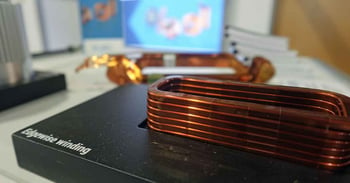
Beyond core configuration, coil geometry also plays a decisive role in performance. Solenoid coils with their cylindrical shape are the most common, offering well-understood field distribution. Flat or pancake coils suit applications with tight axial space constraints, such as implantable devices or wireless charging elements. Selecting the right combination of core type and geometry early in the design process significantly reduces rework and prototyping cycles.
Micro coil manufacturing: wires and core materials
Manufacturing micro coils involves two fundamental decisions: wire material and core material — both of which directly shape electrical performance, reliability, and cost.
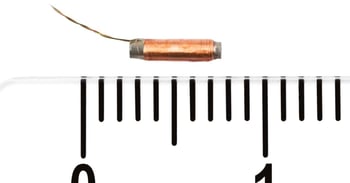
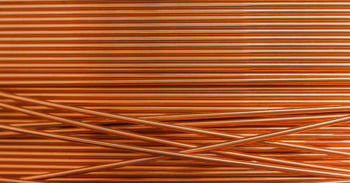
For wires, copper and gold are the most widely used options. Copper is the standard choice due to its excellent electrical conductivity and cost efficiency. Gold wire is reserved for applications demanding the highest corrosion resistance and long-term reliability, such as implantable medical devices. What makes micro coil winding particularly challenging is the extreme fineness of these wires: diameters as small as 0.008 mm / AWG 58 make them practically invisible to the naked eye, requiring specialized winding equipment and rigorous process control.
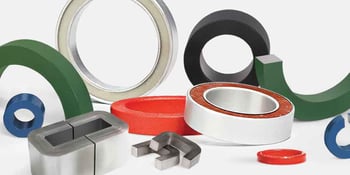
For core materials, the main options are ferrite, iron, and composite materials. Ferrite cores offer high magnetic permeability combined with low electrical conductivity, keeping eddy current losses minimal — a key advantage in high-frequency designs. Iron cores provide higher magnetic saturation but come with greater electrical conductivity, which must be accounted for in the design. Composite materials, such as powdered iron in an epoxy matrix, allow engineers to fine-tune the magnetic and electrical properties for specific application requirements.
Ultimately, the choice of wire and core material is driven by the target electrical and magnetic properties, the operating environment, cost constraints, and the specific requirements of the application.
/Micro%20coil%20air%20core%207.png?width=570&height=500&name=Micro%20coil%20air%20core%207.png)
/Micro%20coil%20on%20core%205.png?width=570&height=500&name=Micro%20coil%20on%20core%205.png)
/Micro%20coil%20air%20core%201.png?width=570&height=500&name=Micro%20coil%20air%20core%201.png)
/Microcoil-lens-coil-700x450px.jpg?width=700&height=450&name=Microcoil-lens-coil-700x450px.jpg)
/Micro%20coil%20air%20core%204.png?width=570&height=500&name=Micro%20coil%20air%20core%204.png)
/Micro%20coil%20air%20core%205.png?width=570&height=500&name=Micro%20coil%20air%20core%205.png)
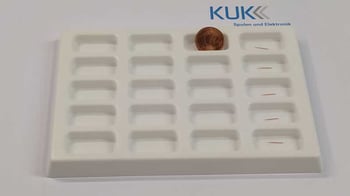
Scale: 0.1 mm / Manufacturer: KUK Group
Applications in medtech: from imaging to implants
Micro coils are central to a wide range of medical technologies, from diagnostic imaging to active implants. In MRI machines, precisely designed micro coils generate and shape the magnetic fields required for high-resolution imaging. Their geometry and placement are critical: even small deviations affect field uniformity and image quality.
In implantable devices such as neurostimulators and pacemakers, micro coils handle wireless power transfer and data transmission, removing the need for physical connectors that would otherwise pose infection risks and limit device longevity. The combination of minimal size, high efficiency, and long-term biocompatibility makes micro coils irreplaceable in this field — and as device miniaturization continues to advance, demands on coil precision and consistency will only increase.
Micro coils in sensor technology: enhancing precision
Custom-made micro coils are also widely used in sensor technology to enhance precision and sensitivity. In pressure sensors, temperature sensors, and inductive proximity sensors, micro coils act as transducers, converting changes in physical parameters into electrical signals that can be precisely measured and analyzed.
Their small footprint allows integration into compact sensor housings without compromising sensitivity. In industrial automation, micro coils enable precise, non-contact measurement of position and movement even in harsh environments. From automotive sensors to biomedical sensors, consistent inductance values and tight tolerances are essential for reliable performance across the full operating range.
Challenges in micro coil manufacturing
The manufacturing of micro coils presents several challenges that require specialized expertise to overcome.
Precise positioning and alignment of the coil windings is critical — tight winding tolerances are needed to achieve the desired electrical and magnetic properties, and any inconsistency directly affects coil performance. Equally important is the careful selection and handling of core materials, whose magnetic permeability and electrical conductivity must precisely match the application requirements.
Roswitha Ritter, KUK Product Manager Medical & Sensors, on core material selection for micro coils:
The extreme dimensions of miniature coils make the entire production process inherently delicate. Specialized equipment, tightly controlled processes, and deep materials knowledge are all prerequisites for achieving consistent, high-quality results at scale.