Optimizing windings for losses and space in radial flux motors
Balancing wire cross-section, fill factor, and losses poses a core challenge in radial flux motor design, where AC/DC effects like eddy currents and skin effect impact efficiency and thermal performance. The optimal choice - whether single-layer edgewise for loss minimization or multi-layer Litz/orthocyclic for space utilization - depends on an overall assessment of frequency, current, and manufacturing factors to achieve reliable torque density.
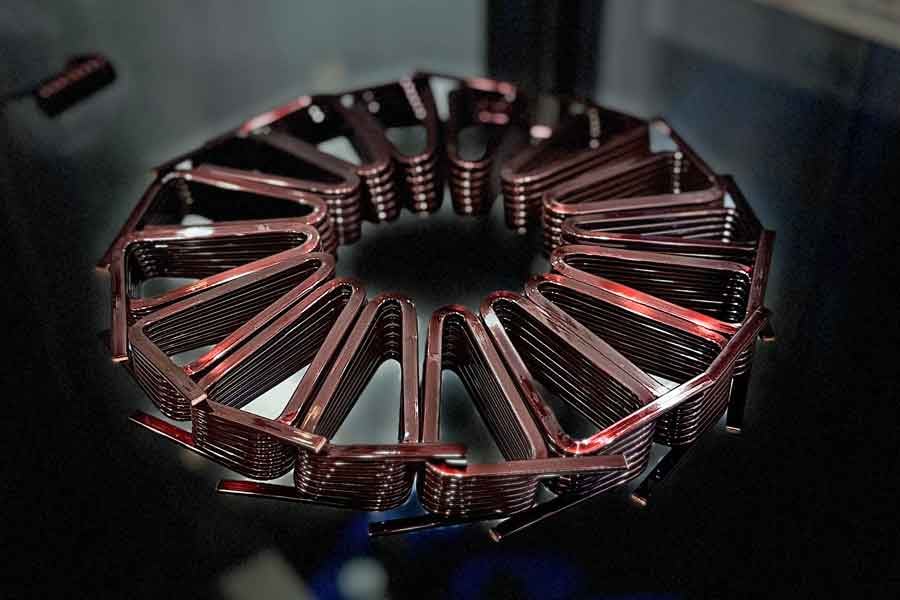 Engineers designing radial flux permanent magnet motors frequently encounter trade-offs in winding configurations that directly impact overall system efficiency and reliability. For instance, prioritizing loss reduction in high-frequency operations may favor compact, single-layer solutions, but space-constrained designs with multiple layers require alternatives that maintain high fill factors while mitigating thermal risks.
Single-layer edgewise windings: ideal for minimizing AC and DC losses
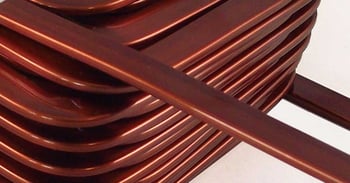
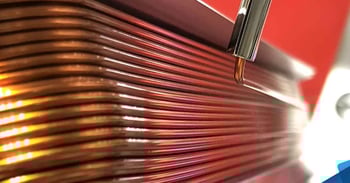
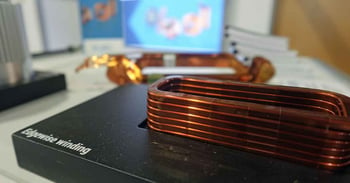
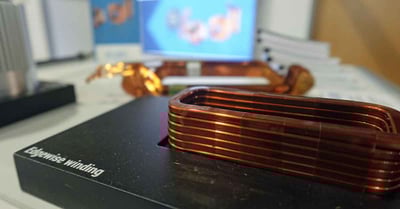
Single-layer edgewise windings, utilizing flat rectangular wire oriented on its edge, provide an effective means to reduce both DC (I²R) and AC losses in radial flux motors. The geometry allows for higher current density with minimal skin effect at elevated frequencies, as the thin profile exposes more surface area for current distribution. Eddy current losses are similarly diminished due to reduced conductor thickness perpendicular to the magnetic field. In practice, this configuration can achieve fill factors exceeding 70%, making it suitable for high-power applications where thermal hotspots must be avoided, though it demands precise manufacturing to prevent insulation failures.
Multi-layer alternatives: Litz and orthocyclic for better space utilization
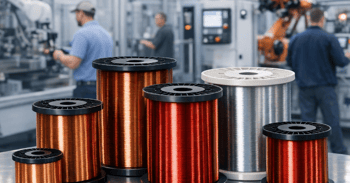
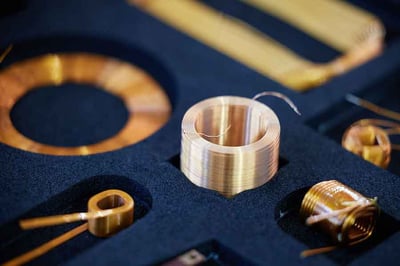 For designs requiring multiple layers due to slot geometry or electrical requirements, Litz wire - composed of multiple insulated strands twisted together - or orthocyclic winding with standard round wire can achieve competitive fill factors (60–80%) while simplifying manufacturing complexity. Litz mitigates skin and proximity effects by distributing current across strands, lowering AC resistance in high-frequency operations, while orthocyclic techniques enable dense packing with minimal air gaps. Compared to edgewise in multi-layer setups, these methods reduce winding complexity and air pockets that could trap heat, improving thermal conduction to the stator core. However, they may introduce slightly higher DC losses if strand insulation adds resistance, necessitating careful evaluation against torque requirements.
Critically, single-layer edgewise configurations may still exceed multi-layer fill factors in certain slot geometries, achieving 70%+ efficiency.
The choice between single-layer edgewise and multi-layer alternatives should be driven by a holistic assessment of all design parameters.
Not by inherent superiority of either topology, but by which best serves the specific combination of frequency, current density, thermal constraints, and manufacturing capability.
Frequency and current considerations in winding selection
Operating frequency and current levels are pivotal in determining the optimal winding strategy, but wire diameter constraints and manufacturing feasibility must be integrated into this decision.
High-frequency operations (>100 Hz)
Skin effect becomes pronounced, favoring Litz (for AC-dominant loss mitigation) or edgewise (for combined AC and DC efficiency with minimal losses). These topologies distribute current effectively and reduce proximity-effect heating, maintaining efficiency in demanding applications.
Low-frequency and DC-dominant applications
The selection process is more nuanced than material cost alone and requires explicit attention to wire diameter constraints.
- For moderate currents where the required wire diameter is at or below approximately 1.8 mm, orthocyclic round wire with self-bonding insulation offers cost-effective solutions, as the self-bonding capability eliminates the need for a bobbin and simplifies assembly.
- For higher currents where the required wire diameter exceeds roughly 1.8 mm, self-bonding wire is no longer available, making standard orthocyclic solutions infeasible. In these high-current DC scenarios, edgewise flat-conductor designs become the optimal solution, delivering superior space efficiency, high fill factors (70%+), and eliminating bobbin costs entirely. While edgewise demands tighter manufacturing tolerances than round-wire alternatives, it can provide the lowest total ownership cost for high-current DC applications by combining material efficiency with simplified assembly and reduced component count.
Current density targets, typically in the range of 4–8 A/mm², must balance against thermal limits, as exceeding these levels amplifies losses and saturation risks. Engineers can use analytical tools like finite element analysis (FEA) to model these interactions, incorporating relationships such as effective resistance  , where
  denotes the critical frequency for skin effect onset, to ensure designs align with EV or industrial motor specifications. Wire diameter selection should precede topology selection to avoid designing around infeasible manufacturing constraints.
From design validation to prototype: ensuring thermal reliability
Validation involves thermal FEA and loss mapping to predict hotspot temperatures, comparing simulated I²R and eddy losses against prototype dynamometer tests. Discrepancies often stem from real-world tolerances in wire cross-section or fill factor variations. To bridge this, iterative prototyping with controlled winding processes is essential. Engaging a specialized coil manufacturer early can refine these aspects, delivering custom windings that maintain thermal integrity and performance consistency from lab to production.