Overmoulding with IDC in automotive solenoid coils
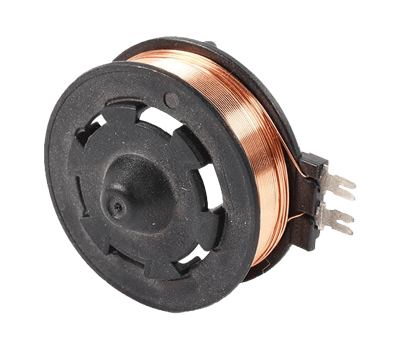
Electromagnetic coils used in the automotive industry — such as in solenoid valves for tank pressure compensation, fluid transport, fuel supply, or hydraulic control — benefit greatly from combining Insulation Displacement Connection (IDC) with overmoulding. This article examines the technical aspects, processes, advantages and disadvantages, and relevance for specific applications.
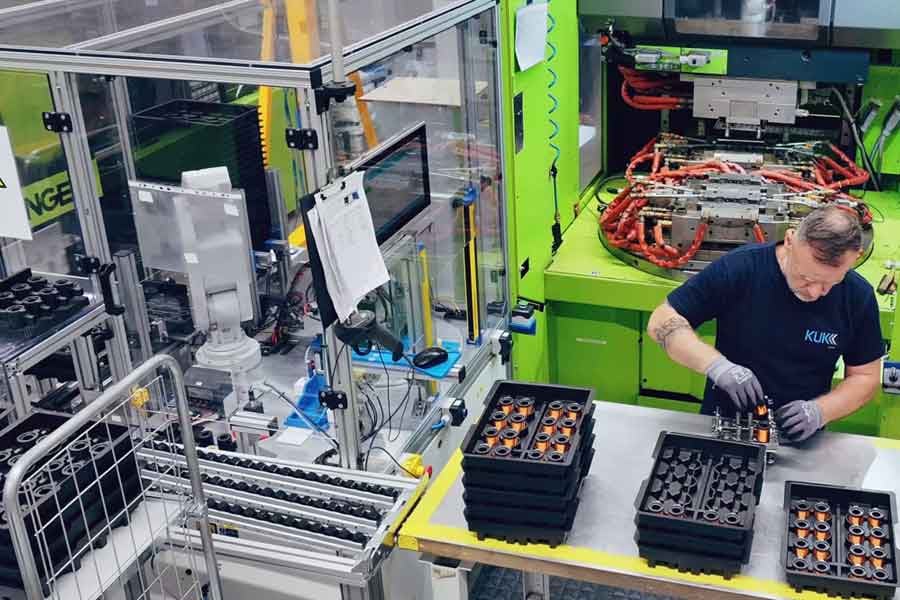
IDC enables efficient wire termination without stripping, while overmoulding hermetically seals and protects the components. Together, they improve robustness against vibration, moisture and chemical exposure — all common challenges in vehicle environments.
Fundamentals: IDC and Overmoulding
IDC, also known as insulation displacement termination, mechanically penetrates the wire insulation with sharp contacts to establish a conductive connection — ideal for fine coil wires (0.1–0.8 mm / AWG 20–38) in modular systems. In overmoulding, the IDC connection together with the coil is embedded in thermoplastic materials such as polyamide (PA6/66) or polyphenylene sulphide (PPS) by injection moulding. This combination reliably protects the sensitive IDC contacts against environmental influences — particularly in demanding applications where unprotected connections must be potted or overmoulded to ensure impact resistance and tightness.
Process: From Termination to Sealing
The typical sequence begins with IDC termination: the IDC contact is pressed onto the insulated wire, cutting through the insulation and contacting the conductor (copper or alternative materials). The coil is then placed into an injection mould. Variants include low-pressure moulding for sensitive components or high-pressure injection for dense, robust structures. Materials such as PBT or PPS are processed at temperatures of 220–350 °C, with glass-fibre reinforcement for additional mechanical stability. Masking elements (e.g. silicone) protect the IDC contacts from material ingress, preserving their flexibility. In automotive applications, hermetic sealing to IP67 standards is frequently achieved through the integration of connectors such as AMP Superseal.
Advantages and disadvantages of combining IDC and overmoulding
Advantages:
-
High automation potential: IDC reduces assembly steps; overmoulding integrates protection in a single operation — ideal for high-volume production.
-
Increased durability: Overmoulding shields IDC connections from dust, condensation and pressure; combined with IDC, this creates a gas-tight, corrosion-resistant unit.
-
Mechanical and electrical reliability: Low contact resistance through IDC, vibration damping up to 50 g, and improved heat dissipation through tight material fit.
-
Cost savings and functional integration: Elimination of separate housings, embedding of leads and sensors in one process, and reduced assembly complexity.
Disadvantages:
-
Thermal and mechanical stress: Differences in thermal expansion coefficients between wire, IDC contact and overmould material can cause micro-cracks or delamination.
-
Limited robustness under extreme loads: IDC is more susceptible to vibration and pulling forces than crimping or welding; overmoulding mitigates but does not fully replace these methods.
-
Process complexity and investment: Clean surfaces, precise temperature and pressure control, and costly tooling are required; misalignment quickly leads to rejects.
Application examples and technical considerations
In solenoid valves for EVAP systems (tank pressure compensation), the combination protects against fuel vapour and moisture; IDC enables fast termination while overmoulding ensures tightness. For hydraulic valves in transmissions, the solution offers pressure resistance up to 200 bar. In fuel supply lines, chemical resistance against fuels is the priority — overmoulding significantly improves performance here. In fluid transport applications, IDC minimises production time while overmoulding integrates isolation against electrical interference. Key tests include helium leak testing for tightness and vibration cycles according to AEC-Q100. Parameters such as injection speed and cooling time must be carefully optimised to preserve the integrity of the IDC contacts — for example, avoiding overheating that could impair conductivity.